Finding an exercise routine is often harder than finding the time to exercise.
Many workouts require:
- A gym membership
- Special equipment
- Heavy weights
For many seniors, the challenge is that most exercise routines place too much strain on the joints. Resistance bands make strength training more accessible. They allow seniors to build muscle safely at home while keeping joint stress low. This guide covers five resistance band exercises for seniors and how to perform them correctly.
10-Minute Resistance Band Exercises for Seniors
Do 2 sets of 10 to 12 reps for each exercise, resting for 20 to 30 seconds between sets. Once you are familiar with the movements, the entire routine should take about 10 minutes.
1/ Seated Row

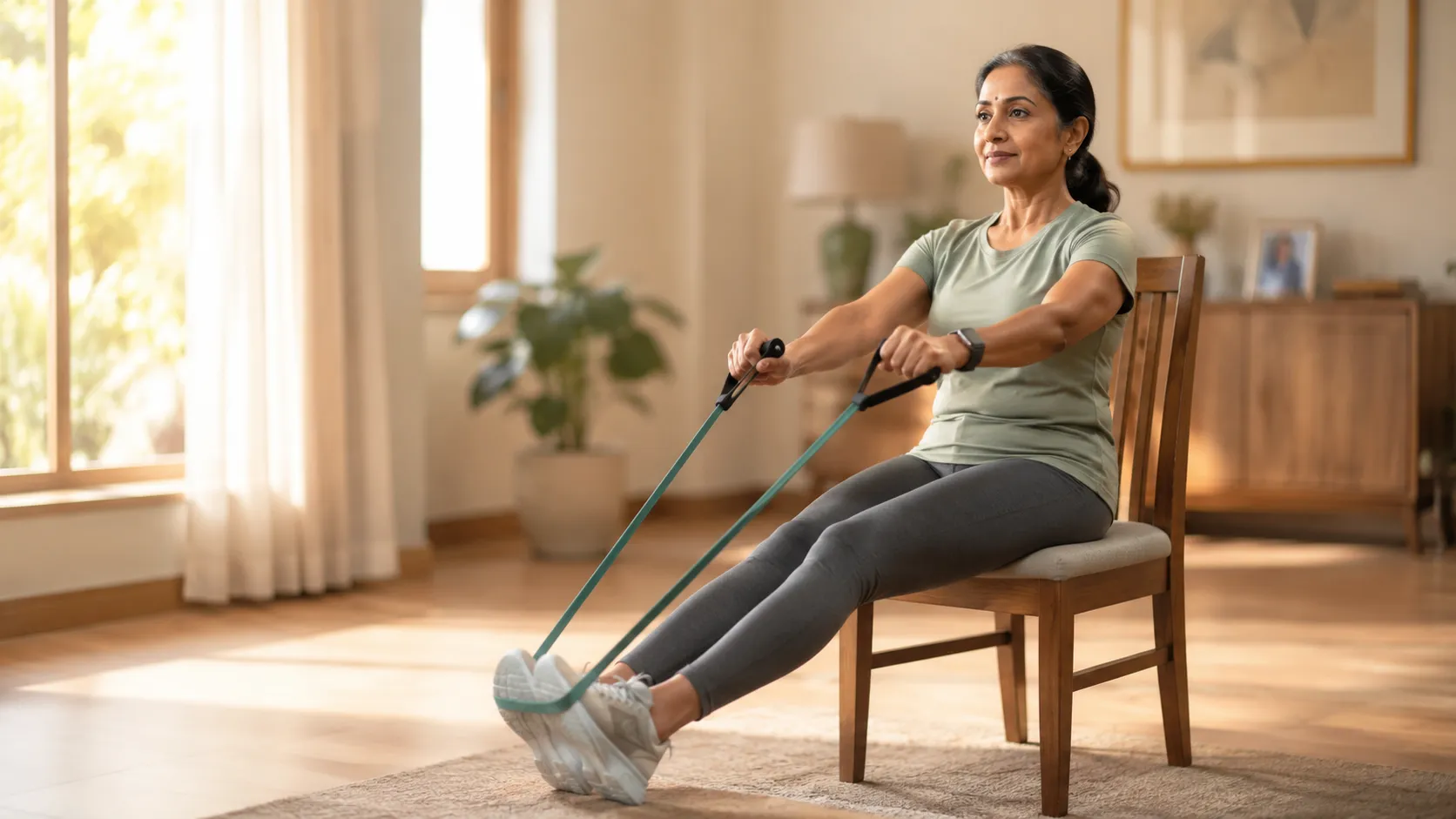
Sit on a sturdy chair with your legs extended forward. Loop the band around the soles of your feet and hold one end in each hand with your arms straight. Pull both hands toward your waist, bending at the elbows and squeezing your shoulder blades together. Slowly return to the starting position.
Why it matters: Strengthens the upper back and helps improve posture.
2/ Bicep Curl

Stand with both feet on the centre of the band and hold one end in each hand with your palms facing forward. Keeping your elbows close to your body, curl both hands toward your shoulders, then lower slowly. This exercise can also be performed while seated.
Why it matters: Helps maintain the strength needed for carrying and lifting everyday items.
For additional hand and forearm strength, you can also try these grip strength exercises for seniors.
3/ Chest Press

Sit upright in a chair and loop the band behind your upper back, holding one end in each hand. With your elbows bent at 90 degrees, push both hands straight out in front of you at chest height, then return slowly.
Why it matters: Builds upper-body strength used in everyday pushing movements.
4/ Banded Squat

Place the band just above your knees and stand with your feet hip-width apart. Push your hips back and bend your knees to lower into a squat as far as feels comfortable. Keep your chest upright throughout the movement. Press through your heels to return to standing.
Why it matters: Strengthens the lower body and makes everyday movements easier.
5/ Lateral Band Walk

Place the band just above your knees and stand with a slight bend in both knees. Step to one side until you feel the band tighten, then bring the other foot in to return to your starting stance. Complete all repetitions in one direction before switching sides.
Why it matters: Improves hip strength and supports balance.
Together, these resistance band exercises for seniors target the major muscle groups involved in everyday movement. The key is consistency. Regular resistance training can help maintain strength and support independence as you age.
Tips for Exercising Safely With Resistance Bands
A few simple precautions can make resistance band exercises for seniors safer and more effective.
1/ Start With a Light Resistance Band
Choose the lightest band available when you are starting out. The goal is to learn the movements and perform them with good form. You can always increase the resistance later as the exercises begin to feel easier.
2/ Check Your Band Before Each Workout
Inspect your resistance band for signs of wear before you begin. Small tears or weak spots can cause the band to snap during an exercise. If you notice any damage, replace the band before using it again.
3/ Pay Attention to Pain Signals
You should feel your muscles working during each exercise, but you should not feel pain in your joints. If an exercise causes sharp or persistent discomfort, stop and rest. If the pain does not improve, speak with your doctor before continuing.
4/ Support Tight or Stiff Areas
If you regularly experience lower back tightness, combining resistance band training with targeted lower back exercises may help improve comfort and mobility.
5/ Focus on Consistency
Strength improvements come from regular practice over time. Start at a pace that feels comfortable and focus on building a routine you can maintain. Small efforts performed consistently tend to deliver better results than occasional intense workouts.
Starting slowly is not a setback. It is often the best way to build confidence, improve technique, and create a routine that lasts.
Resistance Bands Are a Good Start, But Joint-Friendly Strength Training Can Go Further
Resistance bands are an effective way to build strength at home, but they still create some resistance as the band returns to its resting position. For seniors managing stiffness, arthritis, or previous injuries, that repeated loading can sometimes lead to discomfort over time.
Some key limitations include:
- Joint loading during the return phase
- Increased soreness after workouts
- Fixed resistance levels
This is where strength training equipment for seniors, like Ferra, offers a different approach. Ferra uses concentric-only resistance, meaning the machine assists the return phase instead of loading the joints. This helps reduce post-workout soreness while still allowing muscles to work effectively. The resistance also adjusts automatically to your strength level as you progress.
Check out Ferra to build strength with less joint strain and greater comfort.
Conclusion
Getting stronger does not require long workouts or complicated equipment.
Resistance band exercises for seniors offer a practical way to stay active and maintain strength from home. The key is consistency. Small efforts repeated over time can make everyday tasks feel easier and help maintain independence as you age.
Whether you choose resistance bands or a more advanced solution like Ferra, the most important step is to start and keep moving forward.
Resistance Band Exercises for Seniors: Frequently Asked Questions
1/ Are resistance band exercises safe for seniors?
Yes. Resistance band exercises are generally safe for seniors because they provide controlled resistance while placing less stress on the joints than many traditional strength-training methods. Starting with a light band and focusing on proper form can further reduce the risk of injury.
2/ Can resistance band exercises help improve balance?
Yes. Exercises such as lateral band walks strengthen the hips and lower body, which play an important role in stability. For a more targeted approach, these balance exercises for seniors can be a useful addition to a weekly routine.
3/ What resistance band should seniors start with?
Most seniors should begin with a light resistance band. This makes it easier to learn the movements correctly and build confidence before progressing to a higher resistance level.
4/ Can resistance band exercises help with arthritis?
Many seniors with arthritis find resistance bands more comfortable than free weights because the resistance is gradual and controlled. However, exercises should never cause pain. Those managing joint stiffness may also benefit from these arthritis exercises for seniors.
5/ Are 10-minute resistance band workouts effective?
Yes. Short workouts performed consistently can help maintain strength and make everyday activities easier. The key is building a routine that can be sustained over time rather than focusing on workout length alone.