Have you spent your whole life assuming strength training was not meant for you?
Maybe you felt too young for it once. Later, you were too busy. And now you may think you are simply too old.
That assumption is wrong. Research shows adults in their 60s, 70s, and even 80s can build meaningful muscle within weeks of starting resistance training. The body’s ability to adapt never disappears.
What changes is the stimulus it receives. The right strength training over 40 approach can rebuild muscle, improve mobility, and support independence. And it can begin safely from home with exercises for seniors at home.
Why Does Starting Strength Training Now Still Matter?
Many older adults hesitate because they believe they have started too late.
In reality, muscles respond to training at almost any age. A 2019 study published in Medicine & Science in Sports & Exercise–level research found that adults over 65 can gain muscle mass comparable to younger adults after 12 weeks of progressive resistance training.
After 60, inactivity accelerates muscle loss. But even small amounts of training can slow or reverse that decline.
The real benefit of strength training over 40 is not appearance; it is function. Stronger muscles make daily activities easier, including:
- Climbing stairs without holding the rail.
- Standing up from chairs smoothly.
- Carrying groceries or household items.
Starting late is not a failure. It is simply the moment you decided to begin.
What Should Beginners Over 60 Know Before Starting?
Do you need a gym to begin?
No. Many forms of strength training over 40 can be performed safely at home.
Home-based training removes several barriers:
- No commuting.
- No unfamiliar machines.
- No crowded environments.
For many older adults, simple home routines are easier to maintain long-term.
Do you need heavy weights?
Muscles respond to resistance, not necessarily heavy loads.
Light resistance performed with good technique and effort can stimulate muscle growth while reducing injury risk. This approach makes strength equipment training for seniors both practical and safe, especially for people also learning how to prevent muscle loss after 45.
Does joint pain mean you should avoid training?
Joint discomfort does not automatically prevent exercise.
Many older adults benefit from resistance methods that emphasise controlled movements. For example, concentric-focused resistance reduces strain during the lowering phase, making exercise more comfortable for sensitive joints.
Is five minutes really enough to start?
Yes. The minimum effective dose for muscle stimulation is often smaller than people expect.
Short sessions of strength training over 40 performed consistently are more effective than long sessions performed irregularly.
What Is a Simple Beginner Strength Routine for Seniors?
These five beginner movements help activate the muscles most responsible for mobility and stability.
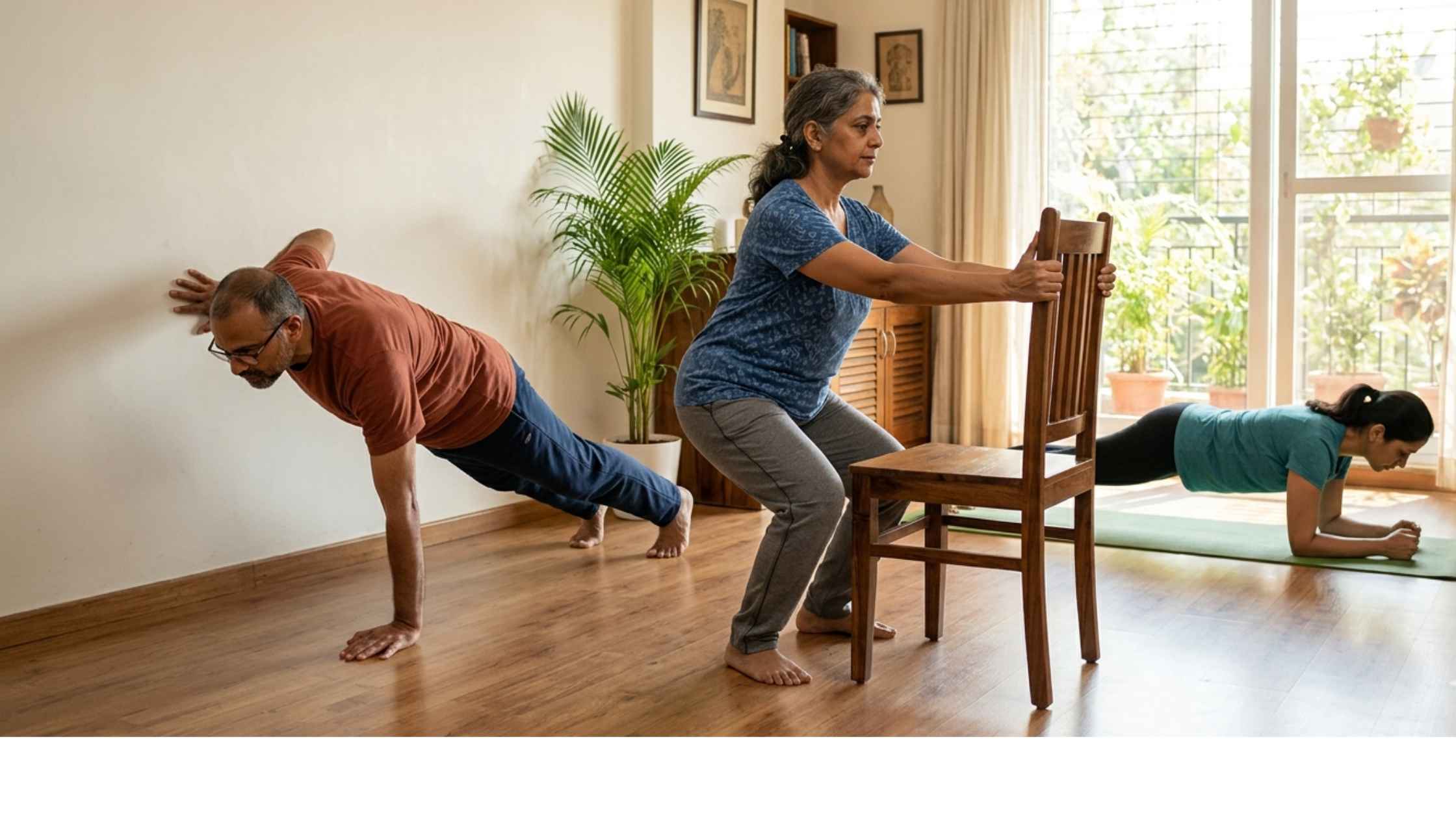
1. Sit-to-Stand (Chair Squat)

How to do it
Sit at the edge of a sturdy chair, stand up slowly, and sit back down with control.
Builds
Leg and glute strength that supports standing and stair climbing.
Safety note
Keep your feet flat and knees aligned with your toes.
2. Wall Push-Up

How to do it
Stand an arm’s length from a wall, place your palms on the wall, bend your elbows slowly, then push back.
Builds
Chest, shoulder, and arm strength are used in daily pushing movements.
Safety note
Keep the body straight rather than bending at the hips.
3. Seated Row with Resistance Band

How to do it
Sit upright, loop a band around a fixed point, pull toward your torso, and release slowly.
Builds
Upper back and posture muscles.
Safety note
Focus on squeezing your shoulder blades together.
Ferra’s seated row uses adaptive resistance that adjusts automatically to your strength level, reducing the need to choose bands or weights manually.
4. Standing Hip Hinge

How to do it
Stand with feet hip-width apart. Bend slightly at the hips while keeping your back straight, then return to standing.
Builds
Glutes, hamstrings, and lower back.
Safety note
The movement should come from the hips, not the lower back. If hip stiffness is already limiting this movement, adding hip pain exercises for seniors can help improve mobility and support around the joint.
5. Calf Raise

How to do it
Stand behind a chair, hold lightly for balance, and rise onto your toes.
Builds
Calf muscles and ankle stability.
Safety note
Lower slowly and with control.
Practised regularly, this type of strength training over 40 can rebuild functional strength safely.
How Can Seniors Turn Strength Training Into a Daily Habit?
Consistency is more important than intensity.
These strategies help beginners maintain the routine:
- Start with two exercises instead of five.
- Perform them at the same time each day.
- Attach the habit to an existing routine, such as after breakfast.
- Track functional improvements, not weight lifted.
For example, notice whether stairs feel easier or whether standing up feels smoother.
Gradually, small improvements reinforce the habit and make strength training over 40 a part of everyday life.
Why Is Starting Strength Training Today Worth It?
Beginning is often the hardest step. Once the routine begins, the body adapts quickly.
You do not need experience or a gym membership. You only need a few minutes and the right movements.
Simple exercises require minimal home strength training equipment for seniors setup and focus on natural movements.
Even simple routines of strength training over 40 can restore muscle strength, improve mobility, and support independence for years to come.
Book a free 15-minute Ferra consultation to discover how structured home strength training can help you start safely.
Disclaimer: Consult your doctor before beginning any new exercise programme, especially if you have existing health conditions.
FAQs on the Safest Way for People Over 40 to Start Strength Training
Can seniors start strength training with no experience?
Yes. Seniors can safely begin strength training using simple bodyweight or resistance exercises. Starting with short sessions and gradual progression helps build strength and confidence over time.
Is strength training safe after age 60?
Yes. Research shows resistance exercise improves muscle strength, balance, and mobility in adults over 60 when performed with proper technique and controlled intensity.
How often should seniors do strength training?
Most experts recommend performing resistance exercises 2–3 times per week. Consistent sessions allow muscles to recover and gradually build strength.
What are the easiest strength exercises for beginners over 40?
Beginner-friendly exercises include chair squats, wall push-ups, resistance band rows, calf raises, and hip hinge movements. These exercises strengthen muscles used in everyday activities.
Why is strength training important after 40?
After 40, muscle mass begins to decline gradually. Strength training helps maintain muscle, improve metabolism, support joint health, and reduce the risk of falls and injuries.